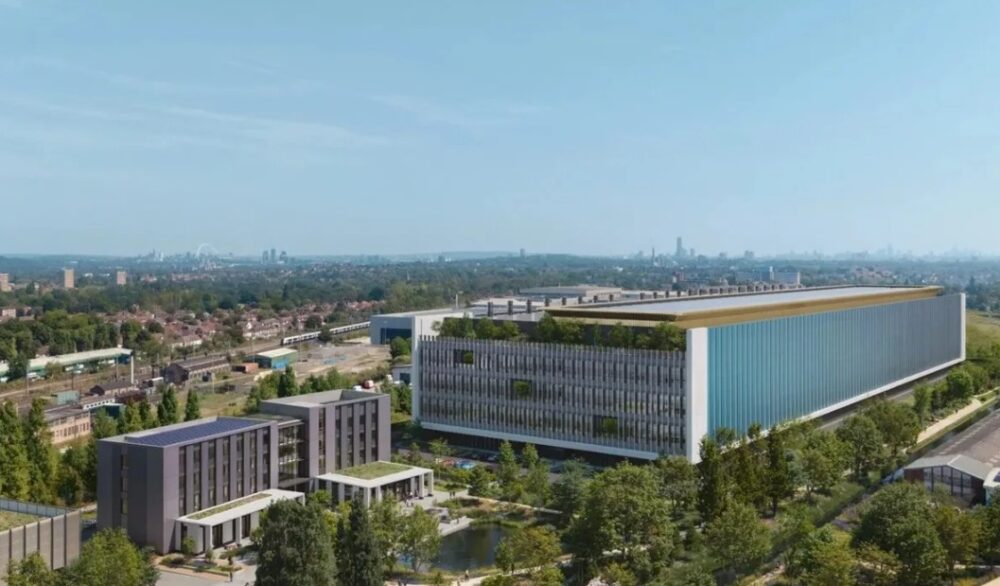

This week CyrusOne secured approval for a hyperscale data centre on a 16-acre site in Southall, and Ealing Council has pocketed £17.8m for the privilege. Datacentres are the most viable asset class on the blocks these days, if and it’s a big if, they can get power.
Before this latest approval, there was another story. The site was a major development which would have unlocked thousands of homes.
That consent has been torn up. It’s returning to an employment use because whilst data centres are the most viable, resi led developments these days are the least viable use. Honey Monster is helpful example to understand London’s brownfield emergency. So let’s dive into it.
The history
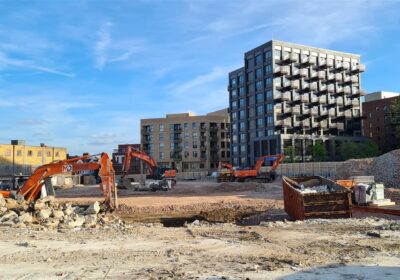
A 10-storey factory built in 1936 for Quaker Oats stood here until 2016, making Sugar Puffs and later Honey Monster Puffs. It was demolished in 2022, three years after Galliard Homes secured consent for Quayside Quarter: 1,997 flats, a 22,311 sqm creative industrial hub and film studio, up to 29 storeys, phased over ten years, with 35% affordable housing signed off by the Mayor’s office at Stage 2. On paper that’s a serious pipeline of new homes for a borough that needs them.
However, planning policy doesn’t treat these types of proposals as welcome events. First, the site was a Locally Significant Industrial Site, and the residential-led scheme could only proceed as a formal “Departure from the Development Plan” — it needed Secretary of State sign-off because housing wasn’t the policy-sanctioned use here to begin with. So the scheme was structured as industrial-first: a condition of consent barred any residential construction from starting until a creative hub was built and operational. Shoe horning employment space in with residential is a balancing act at the best of times – policy was asking a lot and reality bites.
Viability
The scheme’s own viability appraisals showed it losing money. Gerald Eve’s assessment for the applicant put the developer’s profit at -46.48% of GDV, against a 16.9% target. The council’s independent check, by DVS, was less severe but still negative: -12.21% against a 15.46% target.
Both appraisals agreed the scheme didn’t clear the bar for viability, deficit or not, which is why the 35% affordable housing offer was accepted as “the maximum reasonable” rather than tested against any real surplus. The applicant was threshold chasing to avoid being hammered by a late stage review. They offered more affordable than the scheme could support so that they wouldn’t suffer profit squashing and other nasties that come with an LSR.
In plain terms: on the developer’s own numbers, in 2019, before Covid, before the interest rate cycle, before construction cost inflation, Quayside Quarteras as it was known, was already underwater. And it was gated behind building the most expensive, bespoke, single-use element of the whole masterplan — two sound stages and a production building — before a single flat could go up.
What it tells us
The data centre isn’t displacing a live housing pipeline. It’s filling a hole left by a scheme that was a policy exception from day one and never cleared its own viability test.
The building came down in 2022 and nothing was built in its place — not surprising for a scheme that needed to fund an unprofitable industrial anchor before it could touch the housing that was meant to cross-subsidise it.
The real story here is a resi scheme that didn’t survive its own viability assessment and that’s because policy asks for too much with too many conditions. Cycles change and landowners can do other things in a global city.
None of that resolves the grid capacity question, which Ealing has still only answered with a promise to sort infrastructure out later, or the fact that £17.8m and 650 jobs is a modest trade for a 16-acre plot.
There are useful lessons in the housing-versus-data-centre example that Honey Monster offers.