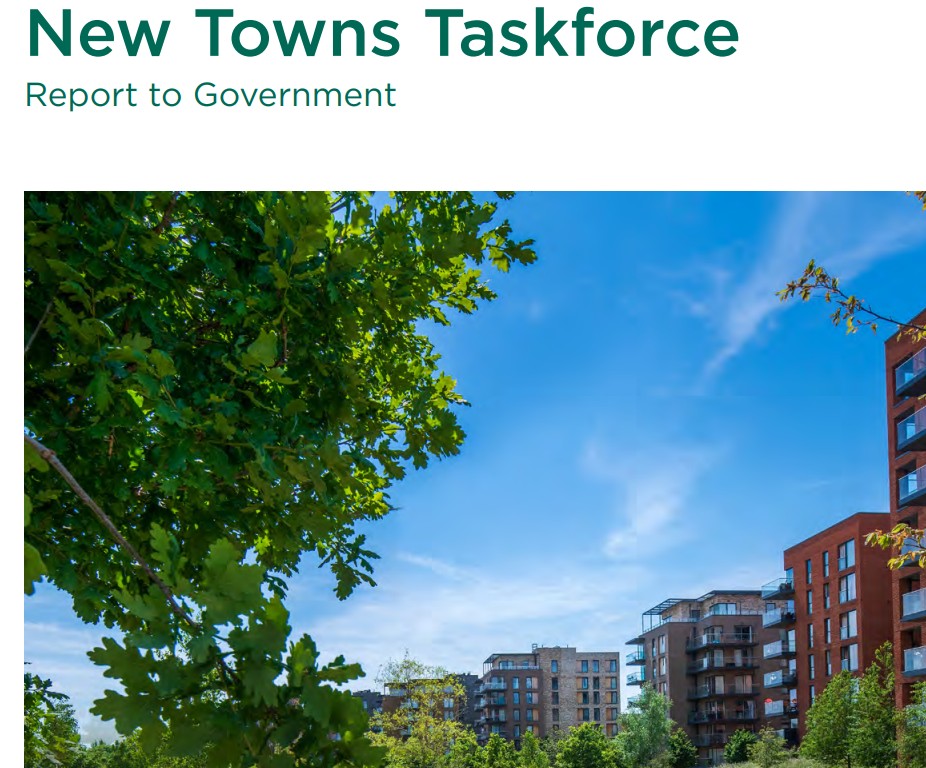

Just over a week ago the Government published its blueprint for the next wave of New Towns. It should be cautiously welcomed. The report is the closest I have seen to a genuinely strategic national plan for housing.
One of the things I have learnt over the years is that every organisation, no matter how large or small needs an overriding purpose. If you lose sight of an overall outcome, things get tied up in knots. Look at the planning system. It is stuffed full of competing and often contradictory aims. I am not sure I can tell what its primary function is and I am a town planner by training.
A national strategy for housing growth, which this paper appears to be, gives strategic focus to the country and its decision makers both national and local. It allows us to make trade-offs as a nation and find solutions to the many logjams which sit in the way of putting spades to ground.
The report is nothing if not ambitious. It is also pragmatic. Only a quarter of these new towns appear to be standalone settlements. In fact, many of them are already underway.
The cynic might call this a reheat. I call it sensible. People want to live in established places. Don’t take my word for it look at Northstowe.
If momentum is already there, it means some degree of consensus has already been achieved. It means some amount of capital has already been invested and some amount of infrastructure planning has already taken place. Such projects are the ones which are likely to survive the vicissitudes of the UK political cycle.
Cost v Benefit
Unfortunately, there are also quite a few unresolved issues within this final report. Some acknowledged and some are left for others to pick up the baton.
Let’s start with the ones which are acknowledged. The first is estimating and delivering infrastructure:
The scale of infrastructure required for large-scale developments can be more costly than expected at the outset which often renders them unviable without public sector support. The Taskforce has been made aware of a number of large-scale projects which have stalled or been abandoned altogether, with private sector actors withdrawing from the master developer role due to the increase in development costs since 2011.
Putting in roads, services and other core infrastructure costs a lot of money in the UK. At no point in this paper does the Task Force estimate the size of the bill required for each of the 12 settlements. Perhaps in some cases, the bill has already been footed but you would have thought for this paper to have weight we should know what we are looking at.
Secondly, the report concludes that New Towns should deliver 40% of their homes as affordable. Why 40%? Isn’t this a little heroic. In London, which is the most viable geographic area in the whole country, 35% affordable housing creates negative land values.
Some quick maths:
If we are building 120,000 new homes over these 12 settlements and 40% are affordable. That’s 48,000 homes which will require subsidy in some form.
Let’s say it’s blended at £250,000 a key with fees to build an affordable home. I think I am undercounting but let’s go with that. That’s £12bn of subsidy that’s required either through private sale cross subsidy or grant.
Let’s look at £12 bn in the context of the 10 year settlement of £39 bn the Government is willing to commit to affordable housing in the UK. It represents nearly a third of the nation’s allocation on these 12 settlements.
Now my numbers might be wrong. But going back to the earlier point, what is the cost of the infrastructure that also needs to be put in to serve these homes. If you add the cost of the infrastructure, to the cost of the affordable you have signed up to, you start to get to a true cost per unit for the delivery of New Towns.
It doesn’t quite end there. Where is the estimate for the cost of the 12 development corporations which maybe created? They are going to take seven figure sums to run per annum. There is no detail on mobilisation periods for these new entities, how large they will be and how they will integrate with existing local government fabric.
The report identifies homelessness as major challenge and issue for public services. However, I am not clear how New Towns solve this. Is the paper saying that building new settlements with 40% affordable housing will be places where people on the waiting list will be shifted too? The linkage here is fragile at best and needs more thought.
Conclusion
What we need is a cost benefit analysis. Is a new town home worth the cost as opposed to the cost of unlocking the many thousands of stuck brownfield sites in our major towns and cities. There are over 200,000 homes on consented brownfield land in London. Why don’t we just put some of this money intended for New Towns into those sites and make the homes affordable in established areas where people want to live?
Now overall, I am supportive of what this report is trying to do. But it’s also very British. Its light on maths and avoids confronting trade offs. Some of these settlements could and should happen. But what we don’t want is the housing equivalent of HS2 landing on our doors because we are enthralled with an idea which may have had its day.