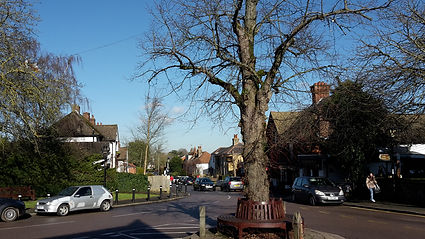

If you want to know how Nigel Farage might think about housing, you have to leave Westminster and travel out to Downe, the Kentish village where he lives. On the map it sits within Greater London. In spirit, it is stubbornly elsewhere. The hedgerows, the pubs, the lanes that lead into the woods, all suggest England before the sprawl.
Earlier this year, Farage walked those lanes with Tom McTague at UnHerd. On the face of it, the interview was unremarkable, one of many he gave that week. But read between the lines and something more revealing came through. He spoke about how Downe’s absorption into the capital “just feels wrong.” Half-seriously, he suggested the village might secede and rejoin Kent. The remark was light, but the sentiment was not. For Farage, development is not a neutral process. It is a diminishment, a slow hollowing out of the country he once knew.
This is the lens through which he may also see housing development more generally. The green belt, in this worldview, is not a planning designation but a cultural frontier. To breach it is to surrender identity.
For pro-growth economists and planners, Britain’s housing shortage is a question of numbers, of too few homes built and too much demand. For Farage, the story is different: it is not a failure of construction but a failure of control. Too many people, too much sprawl, too little belonging.
And yet, politics is not lived in hedgerows alone. Britain is short of homes, and the shortage has become an electoral fact. The young are priced out, families locked in place, businesses warning of growth strangled by a lack of housing. Farage cannot ignore this.
At the Reform UK conference, the party acknowledged the problem. There was talk of rethinking affordable housing, of fast-tracking brownfield sites, of fixing a broken system. It was pragmatic, even conventional.
Here is where the tension increases. A preservationist instinct, forged in Downe, collides with a political imperative to build. And hovering in the background are the Anglo-futurists, those restless pro-growth voices dreaming of new towns, bold architecture, and a Britain remade by scale. They are searching for a political home. But does Farage, with his instinctive defence of hedgerows and cultural frontiers, offer them something closer to hesitation than to fulfilment. He can borrow their impatience with bureaucracy, but not their appetite for bulldozers.
If he sides with preservation, Britain’s housing shortage deepens. Supply will remain throttled, prices high, growth stifled. If he sides with provision, the landscapes he reveres will be changed, perhaps irreversibly. Either way, there is a cost. And that is the heart of the Farage dilemma: he cannot have both England’s green and pleasant land as well as the bulldozers. One will win out.
For pro-growth supporters, this is both the risk and the fascination of a Farage era. They may hope that his insurgent energy could blast through Britain’s planning sclerosis. But Downe suggests a different story, one in which identity, not expansion, holds the upper hand.
Hugo is the policy and politics lead at a London affordable housing developer and writer and commentator on housing matters