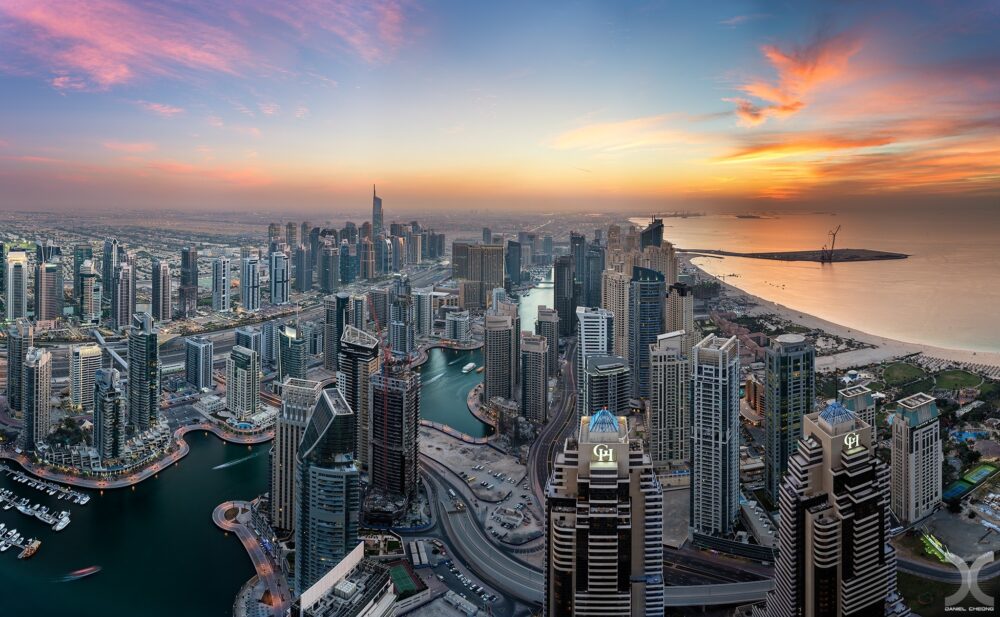

Over the past year I’ve had the opportunity to spend time in some of the world’s most active development markets — Dubai, Abu Dhabi and Riyadh in the Middle East, followed by Brisbane and Sydney in Australia. These visits were not about site tours or individual projects, but about understanding how different systems think about growth, delivery, and the role of property development in nation building.
What struck me most was not any single policy, planning code, or financing structure. It was something more intangible, but arguably more important: leadership and attitude.
Across both regions, there was a prevailing sense of optimism, ambition and momentum. A belief that development is not something to be apologised for or constrained, but a fundamental tool for delivering economic growth, social infrastructure, and long-term prosperity.
That stands in increasingly stark contrast to the mood in the UK — and particularly in London — where delivery feels stalled, risk-averse, and burdened by an ever-expanding web of friction, process, and politicisation.
The Middle East: Development as Nation Building
The Middle East is rightly described as operating on a different “system” to the UK, and that is undoubtedly true. But what is striking is not simply the scale of ambition — though that is undeniable — but the clarity of purpose.
In Dubai, Abu Dhabi and Riyadh, development is explicitly framed as nation building. Real estate, infrastructure, and regeneration are not seen as necessary evils or speculative activities, but as central pillars of economic strategy. They are instruments for diversification, global positioning, job creation, and societal transformation.
The prevailing tone is one of positivity and confidence: we are building something, and we are doing it on purpose.
Brisbane: Pragmatism and Political Mandate
Australia offered a different but equally instructive perspective. I met the Deputy Premier of Queensland, Jarrod Bleijie, in London last year, and later met with his advisor during my visit to Brisbane. Bleijie is overseeing the delivery of the 2032 Olympic and Paralympic Games — one of the largest urban and infrastructure programmes in the country.
What stood out was not just the scale of ambition, but the political clarity with which decisions were being made. When challenged by the International Olympic Committee on not adopting a particular level of sustainability standards — at an additional estimated cost of over $1 billion — Bleijie’s response was simple and revealing: that is not what the people of Queensland voted for; that money is better spent on essential public services.
Similarly, when questioned in Parliament about the government’s “adult time for adult crime” policy, and told that a UN representative had raised concerns, the Premier’s response was equally direct: the people of Queensland didn’t vote for the UN.
Whether one agrees with those positions or not is almost beside the point. What matters is that they demonstrate political confidence, democratic mandate, and a willingness to own decisions.
There is a sense in Brisbane that the system exists to deliver, not to defer; to make choices, not to hide behind process. The city itself reflects this: clean, well-run, visibly growing, and supported by a pro-development culture that sees growth as something to be managed, not feared.
London: From Leadership to Paralysis
The contrast with London is uncomfortable. Delivery feels slower, more constrained and more fragile than at any point in recent memory. Major schemes stall. Infrastructure is delayed. Investment hesitates. Developers and investors face rising uncertainty, shifting goalposts, and an increasingly adversarial political narrative.
Yet this was not always the case. Earlier in my career, I worked under strong local and city leadership that actively embraced development as a force for good.
At Southwark Council, working for then-Leader Peter John, there was a clear strategic vision for the borough: how regeneration could deliver homes, jobs, transport, and social infrastructure. The council did not see development as something to be endured, but as something to be shaped.
Later, at Battersea Power Station, I spent years negotiating with Ravi Govindia, the long-standing Leader of Wandsworth Council. Whatever one’s politics, there was never any doubt about his ambition for the borough or his belief in what regeneration could achieve for local communities.
At the mayoral level, commentators like Jonathan Prynn have written about how both Ken Livingstone and Boris Johnson were ‘dealmakers’, doing business with developers to secure strategic priorities — housing, transport, public realm, employment. They understood that cities are built through partnership, not permanent opposition.
Leadership did not mean the absence of scrutiny or negotiation. It meant clarity of intent, confidence in outcomes, and a belief that growth could be steered rather than suppressed.
Leadership Is Not a Silver Bullet — But It Is a Force Multiplier
Leadership alone will not solve the UK’s structural challenges: high construction costs, labour shortages, complex regulation, viability pressures, political volatility, and a fragile economy. But leadership is a force multiplier.
It shapes culture. It signals confidence to investors. It gives permission to officials to enable rather than obstruct. It frames development as part of the solution, not part of the problem.
Where leadership is proactive, clear, and positive, systems tend to align around delivery. Where leadership is hesitant, defensive, or contradictory, systems become paralysed by risk management, consultation loops, and institutional caution.
The irony is that the UK — and London in particular — needs development more than ever.
The real estate sector underpins vast parts of the economy: housing delivery, infrastructure funding, pension investment, employment, professional services, supply chains, local businesses, and tax receipts. It is one of the few sectors capable of generating large-scale, place-based economic growth.
Yet politically, it is often treated as something to be at best tolerated, at worst blocked.
Relearning an Old Lesson
What my travels reinforced is not that London should copy Dubai, Riyadh, or Brisbane. The UK’s governance model, legal system and social contract are fundamentally different — and rightly so.
But London could relearn something it once understood very well: that strong, confident, accountable leadership matters.
That cities are built by people who are willing to make decisions, articulate visions, take responsibility, and work with — not against — those who deliver. That development is not just about buildings, but about belief: belief in growth, in progress, in partnership, and in the future of the city.
Perhaps it is the weather. Perhaps it is economic confidence. Perhaps it is simply political culture. But standing in Brisbane, watching a city prepare itself for a global moment in 2032, it was hard not to feel that London — once the undisputed leader in urban regeneration (and a former Olympic host city) — has lost some of its nerve.
Not its talent. Not its institutions. Not its potential. Just its confidence in itself.
And confidence, ultimately, is a leadership choice.
Gordon Adams was for over a decade the Head of Planning and Public Affairs at the Battersea Power Station Company. Prior to this, he was a team leader in the Major Applications at LB Southwark. He was also a former Planning Committee Member at the Old Oak and Park Royal Development Corporation (OPDC). He now runs his own planning and development consultancy, Crooble.