
Planning reform is everywhere. New targets. New thresholds. New rules for committees, appeals and plan-making.
Yet one weakness remains largely untouched: how the system understands public opinion. Traditional consultation is dominated by people who are already engaged, highly motivated or directly affected. Their views are legitimate, but not necessarily representative.
Younger people, renters, working households and people waiting for affordable housing are routinely absent. They may benefit most from development but are unlikely to attend an exhibition or navigate a planning portal.
The result is an evidence gap. Committee reports may record hundreds of objections without telling councillors whether those views are shared by the wider community. Volume becomes a proxy for sentiment. Participation is mistaken for representation.
Schemes are then redesigned or reduced in response to the most organised voices.
Viability is squeezed, affordable homes are lost and infrastructure projects face rising cost and delay. The problem is not that opponents are heard. It is that too few other voices are heard alongside them.
Our new good practice guide, Representative Planning: the missing piece in planning reform, distinguishes between two forms of engagement.
Planning needs two kinds of listening
Good neighbour consultation focuses on ‘communities of place’: those closest to a proposal. It identifies local impacts and explores reasonable mitigation.
Representative engagement focuses on ‘communities of interest’: those who need, use or benefit from the homes, infrastructure, jobs or services proposed. It hears from a more representative sample through polling and deliberative panels.
One mitigates impacts. The other improves the evidence. Together, they can build a public mandate. Neither should cancel out the other.
Same site. Same scheme. Same question.
We recently compared both approaches on the same housing proposal.
The question was identical: “Do you support the applicant’s plans for new homes?”
Among a representative sample:
70% said yes. 30% said no.
Through traditional, self-selecting consultation:
4% said yes. 96% said no.
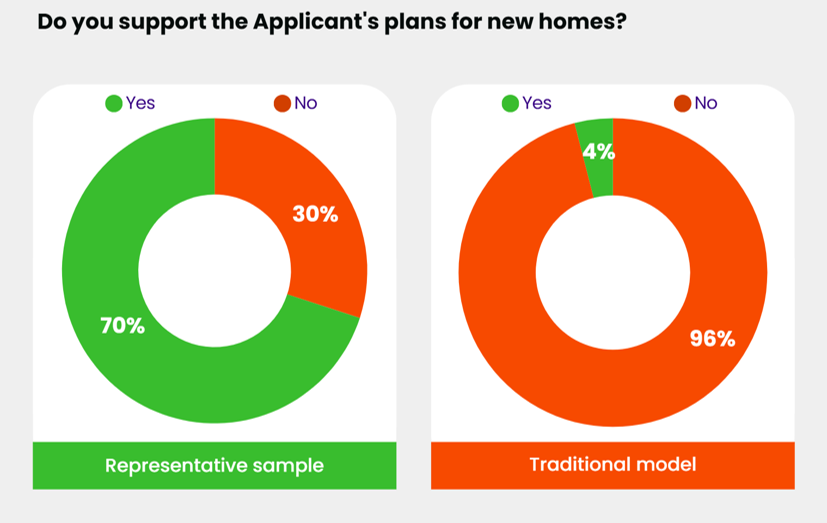
The traditional exercise was not wrong. It captured those motivated to participate but did not reliably measure wider sentiment.
A councillor looking only at that response might conclude that the community was overwhelmingly opposed. The representative evidence suggested the opposite. Support should not override planning considerations or genuine local concerns. Decision-makers need to see both.
Evidence, not activity
Traditional consultation records exhibitions held, leaflets delivered, website visits and responses received. None tells us whether engagement was representative or useful.
We should ask who was reached and missed; whether communities of place and interest were both included; whether support and opposition were reported equally; and whether engagement improved the proposal.
We also need to distinguish testimony from volume. A short, personal account should matter more than repeated, templated or AI-generated submissions designed to create superficial numerical weight – whether they support or oppose development.
Planning portals should make it as easy to support as to object. Committee reports should treat both equally. That is not pro-development bias. It is procedural fairness.
Our guide turns these ideas into ten principles and an assessment framework. It is not proposed that Representative Planning becomes a new statutory process. It is not about doing more engagement but doing it better.
The sector spends millions on public exhibitions that too often provide little meaningful insight while fuelling confrontation. Representative Planning provides a framework for using those resources more effectively and improving the quality of community evidence available to decision-makers.
The missing piece in planning reform
Representative Planning will not manufacture consensus. Its purpose is to give decision-makers a fuller understanding of community opinion.
Good engagement should be judged not by activity, but by whether proposals improved, participation broadened and decision-makers received better evidence.
The system must continue to hear those most affected by development. But if reform is to deliver the homes and infrastructure Britain needs, it must also hear the wider community planning exists to serve.
It is time to hear the whole community – not just those who shout the loudest.
Download Representative Planning: the missing piece in planning reform here.
Wyn Evans is co-founder and director of Shared Voice, a planning communications agency that helps organisations understand community sentiment and build a public mandate for development. Shared Voice is an accredited member of the British Polling Council.