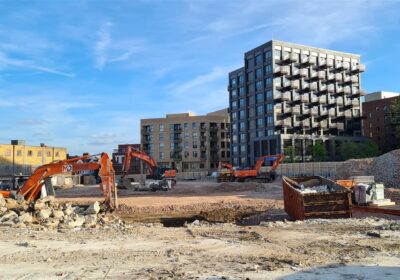
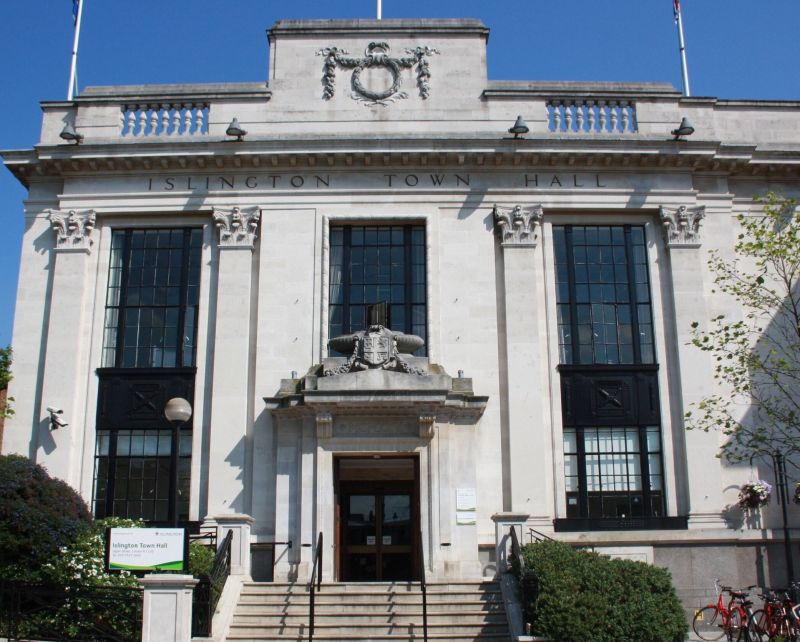

The growing row in one of Labour’s strongest local authorities around a broken promise to deliver council housing could snowball quickly to become a real problem for Prime Minister Andy Burnham and his returning Housing Secretary, Angela Rayner.
On the surface, this is a local political scuffle around a piece of public land next to a community centre that was funded jointly by the council and local community fundraising. Back in 2017, the council promised to build council housing on the adjoining land, which its own Executive papers record it holds ‘for housing purposes’ under the Housing Act 1985.
Several years later, it decided instead to allocate that land for caravan pitches for Gypsies and Travellers. That allocation was brought forward as part of the Local Plan and thrown out in 2023, when planning inspectors, one of whom was Christa Masters, found all three of the council’s Gypsy and Traveller allocations unsound, two because the land was not ‘available or deliverable’ and Ronalds Road, Highbury, because the council had not shown the site could give anyone living there suitable conditions, given the railway and the tunnel beneath it.
Their letter of 22 February 2023 put it plainly: “We note that the Council is of the view that such matters can be addressed through detailed design at the planning application stage. However, in the absence of any evidence to show that there is a reasonable likelihood that such adverse effects could be suitably mitigated (bearing in mind the nature of gypsy and traveller accommodation) and that suitable living conditions are possible, we are unable to find the allocation sound.” Detailed design would sort it. Three and a half years later there is no topographical survey, no coordinated drawing of the three pitches the council now proposes, no fire strategy and, in the council’s own words on 21 August, ‘no detailed designs and therefore no estimated figures of delivery or management costs’.
But this is not about anyone’s objections to housing Gypsies and Travellers. It’s about the council’s disregard for process, transparency, a democratic consultation process and, more worryingly, press freedom.
And it has already become a national debate as mis-steps, leaks from the council and FOI responses reveal the full drama unfolding in Jeremy Corbyn’s constituency. So why does anyone outside the north London bubble care?
First, transparency in democracy. To avoid press scrutiny, in an act reminiscent of Donald Trump, the council has removed the press release where it promised to build the council housing from its main website following media inquiries.
You can still find the original story in the local press here, of course. The council has also rebuffed numerous Freedom of Information requests, often doing so incorrectly, citing a £450 cost limit and a ‘section 36’ exemption from the Freedom of Information Act to answer requests made under the Environmental Information Regulations, where neither exists. However, through a mixture of incompetence and necessity, it has revealed a number of fascinating facts about its process failures that I’ll come on to shortly.
The Local Plan-making process should be about transparent community debate. Not about a council deciding what it wants to do and ploughing forward with that decision in spite of what people actually want and what legal process demands.
Second, trust in the independence of planning inspectors.
One of the FOI revelations is how aforementioned planning inspector Christa Masters, who co-signed the 2023 report that threw the site out, was brought in by the council as a supposed ‘critical friend’ while it worked through the objections to putting the same site forward again. The council confirmed the information ‘is held by Islington Council, by law’, refused to say how much she was paid and, tellingly, in refusing it cited a clause around commercial competitiveness, which clearly implies she was paid.
Currently, there’s nothing improper or illegal about this. But there should be, as it raises intense moral questions around the planning system and the supposed independence of the Secretary of State’s inspectors. Rayner and Matthew Pennycook are now facing calls to review this. The Inspectorate’s own Conflict of Interest Policy lists ‘consulting, advising or volunteering with local planning authorities’ among the interests inspectors must declare, and its procedure guide says at paragraph 1.11 that an inspector who holds an advisory meeting on a plan would not then be appointed to examine it. Note the direction of travel: advice first, examination barred second. Nobody wrote a rule running the other way, because until now nobody needed to.
Third, the consultation process itself has been a total fix. Local plan-making processes should be open to fair debate, with councils welcoming consultation at points where people can engage. Instead, Islington chose three dates at the height of the summer holidays, knowing everybody would be away, and insisted that people could only attend by strict reservation and invitation.
The consultation deadline was tightly set during the middle of August and it has since been pushed out to 1 September. Anybody can respond to the Regulation 19 process by going here. This matters beyond Islington because this attitude embeds resentment and mistrust of the planning system, which directly fuels the record-low housing delivery numbers we have right now across the country.
Fourth, and most tellingly for this publication, given Inside Housing’s track record of revelation and award-winning reporting around Grenfell, is fire. For those who haven’t traipsed around Highbury after an Arsenal game, this is a small piece of council land, 1,162 square metres, next to a community centre, sitting directly above a live railway tunnel and hard up against an open railway cutting, a short walk from the Emirates Stadium. It’s noisy. It’s cramped. Train noise is plainly audible in homes fifty metres away. In both of the council’s own design options, one static caravan sits directly above the tunnel.
The street outside is inside a Low Traffic Neighbourhood, with narrow roads, dense parking and Ronalds Road itself closed at Arvon Road. That is where caravans and towing vehicles are supposed to manoeuvre. And on match days at the Emirates, the whole thing sits under crowd, traffic and road-closure pressure that would fall directly on a handful of families in caravans, and which not one of the council’s documents assesses.
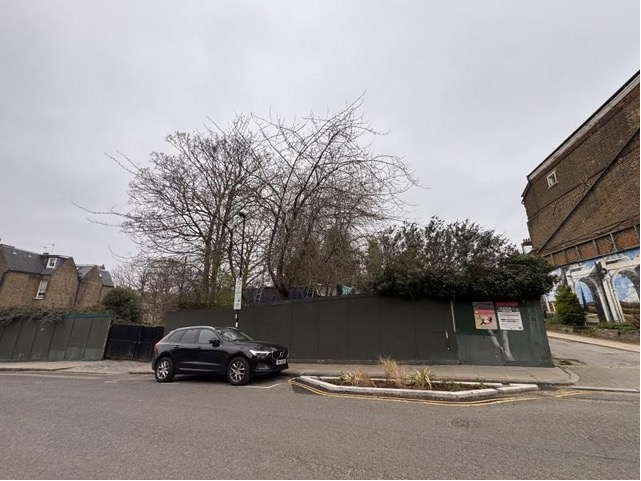
And according to one of the council’s own reports, written by WSP and published on its consultation website, the site is so tight that there’s not enough room to tow a caravan onto it. You’d have to use a crane.
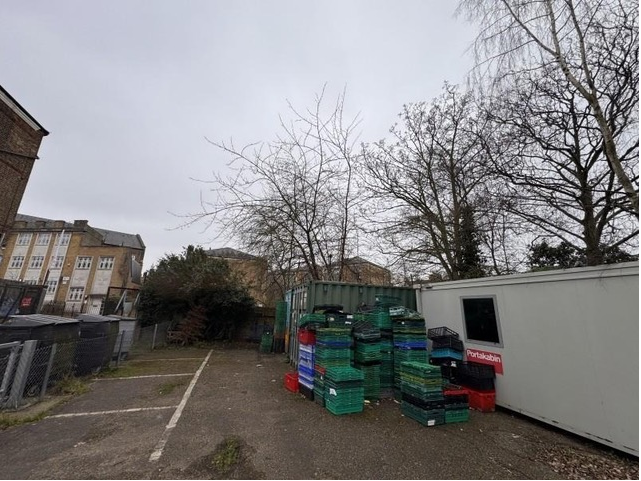
Now sadly, I’m not the boss of JCB, but you don’t need to be to read WSP’s own conditions for craning one in. It wants ground ‘close to level firm ground’ and a final position ‘free of overhead obstructions such as trees and power lines’. This site has a two metre level change across it and mature trees in the middle of it.
And what else does WSP’s report reveal? Nobody went to the site. Everything comes from Ordnance Survey mapping and street view imagery which, in WSP’s own words, ‘may not be up to date’, and the drawings state that all access requirements must be verified on site before delivery. No topographical survey has been carried out. The only standard WSP applied is a 2008 government guide withdrawn in 2015; the London Fire Brigade’s own access note for developers, GN29, is never mentioned. This would be laughable if it wasn’t written in a public document here.
The council’s own architects, HTA Design (who have moved from modular housing to caravans, it seems) told it in writing that if any of these sites went forward, ‘advice should be sought from a fire safety consultant as to the constraints posed by these sites in accommodating Gypsy and Traveller pitches’. Answering objections at the winter consultation, the council said ‘further fire risk assessment input will be sought to inform the proposed site layouts’, 118 times, almost all in the same stock paragraph.
Seven months on, the consultants it has declared paying are architects, site assessors, transport engineers, acousticians and arboriculturalists. Not one is a fire engineering practice. HTA knows what one looks like: for its 23-pitch Traveller site in Sutton it had a named fire engineer, 60-minute fire separation between every pitch and a planning condition to enforce it.
Reading through some of the other FOI responses, which you can read here, the planning inspector who met the council privately in May told it to work with neighbouring authorities and build across local authority borders, as that would make far more sense than doing so on these sorts of totally unworkable sites. The council has published no agreement with a single neighbour. The same inspector warned that several of these sites may breach Islington’s own open space policy, and told the council it would have to show it had judged all nine sites by the same yardstick. It then dropped the two sites its own architects rated better and kept Ronalds Road above the railway tunnel, which they rated joint second worst. The same inspector recorded that the shortlisted sites could take ‘either 1 or 2 pitches’; the plan published two months later puts three on Ronalds Road and three on Aubert Court, an increase made under officer delegation after the Executive had approved two in November 2025.
Tellingly, the council has ignored all of it.
Fifth, and this is the one that should worry the council’s lawyers most, it never seriously looked at anything else.
Back in October 2022, residents put in a 74-page representation, prepared with planning consultants, acoustic consultants and counsel. It set out alternative uses for this land: affordable housing, community green space, a community orchard. There is a primary school on Arvon Road with no outdoor space of its own, a hundred yards away.
Islington’s sustainability appraisal for this plan assesses the pitch use and exactly one alternative, public open space. On housing, it records that conventional residential use ‘has been discounted for this site’. It does not say why. Four words, no reasoning, on land the same council publicly promised for council homes and told its Executive it ‘intends to develop this land for housing’. That matters legally, not just politically. The Environmental Assessment of Plans and Programmes Regulations 2004 require an appraisal to identify, describe and evaluate reasonable alternatives, and to give the reasons for choosing the option it did.
A failure to appraise a reasonable alternative is a legal compliance failure, and the fix is the council going back and doing, in public, the appraisal it skipped. The council was told about these alternatives in 2022 and appears to have done nothing with them.
And the constraints the council does acknowledge are not small. Its own arboricultural survey records 17 trees, groups and woodland features, seven of them Category B with at least twenty years of life left, concentrated exactly where you would want buffers and screening. Its ecological report leaves bat roosting potential in the on-site building unresolved, and flags that lighting a residential site here would spill into the boundary habitats beside the Drayton Park and Olden Garden Site of Importance for Nature Conservation. The indicative layouts convert most of the site to hardstanding. The evidence calls for a topographical survey, an arboricultural impact assessment, a method statement and a tree protection plan, none of which exist. That is not the profile of a deliverable allocation. It is the profile of a site that has not been worked out.
Although it has declared at least £76,727 of spending thus far on consultants, a figure that excludes officer time and whatever its critical friend cost, local council sources put this at nearer half a million pounds spent before anything has been agreed as part of the Local Plan. This is astonishing and totally unacceptable. If this can happen in a Labour stronghold like Islington, it can happen anywhere.
Why is this happening?
Because of a deadline. Under the revised National Planning Policy Framework of December 2024, a plan prepared under the existing system must be submitted for examination by 31 December 2026, or be re-prepared under the system the Levelling-up and Regeneration Act 2023 brought in. That means years of work and a fresh evidence base.
So Islington has four months. That is the pressure behind an allocation assembled at speed, on surveys drawn from Google imagery, with no topographical survey, no fire engineer and no costed delivery route, on a site its own consultants rated second worst of nine. The deadline does not excuse any of it. It explains all of it.
To be clear, nobody locally opposes housing these groups. There are few more liberal, progressive communities on the planet than the one in Highbury. However, there has to be a reality check around what is safe and on what sorts of sites you can safely house people. Similarly, and this goes back to the heart of new Prime Minister Andy Burnham’s pledge, council housing is for everybody.
It’s not a tenure where, although there obviously is a priority list, people are prioritised by race or background. And that is the essence of why Britain needs to embark upon a social housing boom. That requires councils to be open to debate rather than suppressing it, which is what Islington is doing here.
So what to do?
Make a representation to the Regulation 19 process, which closes on 1 September 2026. You can do it through this link and you do not need to be a planner. Objections go to soundness or legal compliance, which means four questions anyone can answer from what is set out above.
Is the plan positively prepared? The council was advised in May to explore meeting this need jointly with neighbouring boroughs, and has published no agreement with a single one. Is it justified? The council’s own architects ranked this site joint second worst of nine. It then dropped two sites they rated better and kept this one, after being told in writing to show it had judged them all by the same yardstick.
Is it effective? Its own transport consultants say a caravan cannot be towed onto the site. There is no topographical survey, no fire engineer, no arboricultural impact assessment and no costed delivery route, against a promised delivery window of 2026/27 to 2030/31.
Is it consistent with national policy? Planning Policy for Traveller Sites requires appropriate locations and the protection of local amenity and the local environment. A site where mitigation has to be argued into existence fails that test.
And on legal compliance, of the seven sites Islington proposes, Ronalds Road is the only one from which the requirement to consult the Gypsy and Traveller community on site design has been left out. On the one site where the homes were shrunk by a third, to 11 metres by 3.8, and the boundary planting replaced by a brick wall, nobody has to ask the people who would live there what they make of it.
Say it in your own words. A hundred and fifty households making the same four points in their own voice carries far more weight than one long document, and anyone who wants to speak at the examination hearings next year has to have made a representation now.
There is an irony in where this ends up. Sadiq Khan’s draft London Plan, published this month, hands Bromley 77 pitches and Havering 73, against Islington’s eleven. A mayor who has struggled to build houses may have stumbled on the answer by sending the problem to boroughs that still have some room in them. Out there you can swing a cat and turn a fire engine.