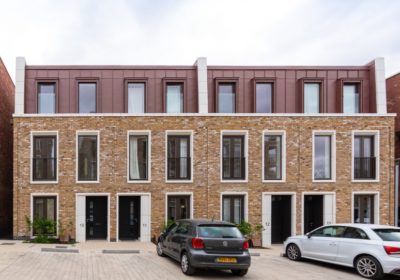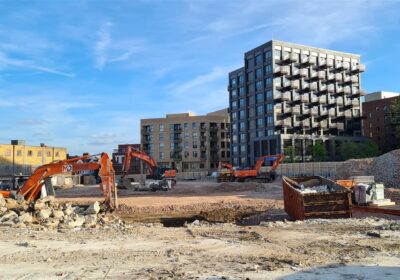
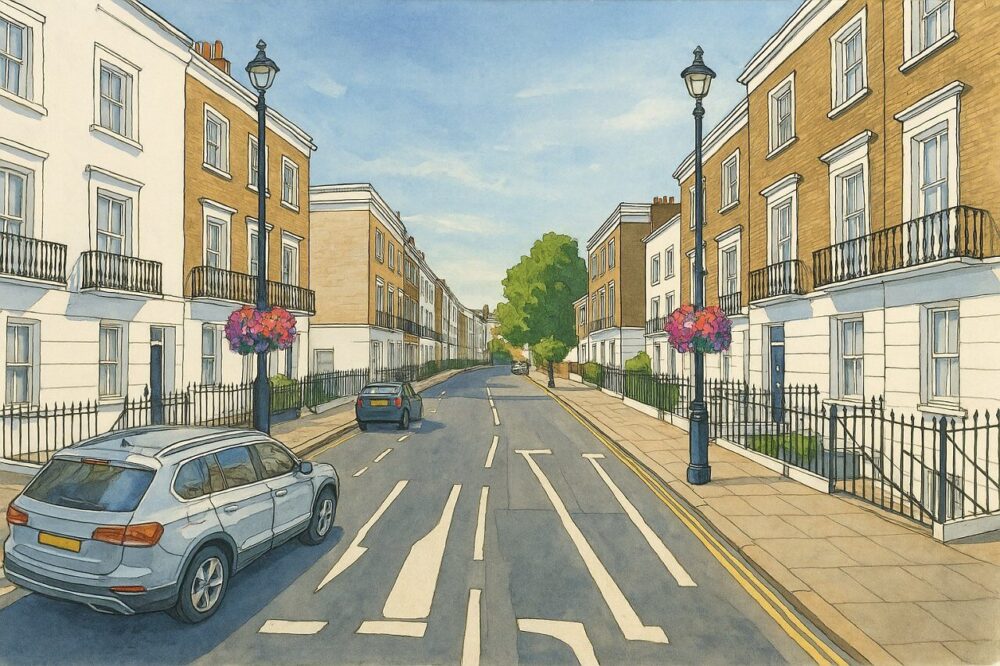

Building more homes in the suburbs is one of those knotty, intractable problems our policymakers have failed to solve. Letting the suburbs evolve naturally would allow more people to live where they want to be, near jobs, friends and family. It would open up opportunities for small builders, whether a block of flats replacing a tired bungalow, an infill plot, or a few homes on an awkward corner, the small sites rather than the strategic allocations that dominate the housing debate. More builders on more sites, selling in parallel, is the route to a higher build-out rate.
Yet few homes get built, because a myriad of rules and requirements make it so hard. Most of those rules were added one by one to appease people who did not want development, or the interest groups that speak for them. New development is routinely presented as something that will overwhelm a local area, and some politicians representing suburban seats make opposing it their raison d’être. So the homes do not come, and in places like London the result is more and more people cramming themselves into suburban neighbourhoods that have barely grown.
And yet we are, in another sense, perfectly comfortable with suburban change. The suburbs have grown a great deal, upwards and outwards, as homes expand with the families in them. Loft conversions, rear extensions, the odd storey on top. Householder work of this kind makes up much of what the planning system does, and a great deal happens through permitted development without any application at all. It is a regime that largely works. Homeowners can enlarge and heighten their homes through a relatively quick and cheap process, and while the criteria are rigid, specified almost to the millimetre, within those lines the rules are legible. They plan around them and make the most of them, adding space and value to their homes. People follow the incentive when the rules make it easy, which is something policymakers tend to forget.
A few councils have written policies to bring these smaller plots for new homes forward, but most don’t, so central government has felt the need to step in. That effort has mostly overlooked the lesson above. Governments have instead tried to thread the political needle, to find a reform that adds homes while keeping everyone happy. In 2020, parliament legislated to give automatic rights both to add two storeys to existing blocks of flats and to demolish and rebuild certain apartment blocks and commercial buildings at higher density. On the face of it these were significant reforms. Ministers thought they had opened a route through the thicket of local policies that thwarts suburban homes. In practice they were barely used, because they came with so many hurdles, on amenity, noise, transport, natural light and the rest, that they ended up looking little different from a standard planning application.
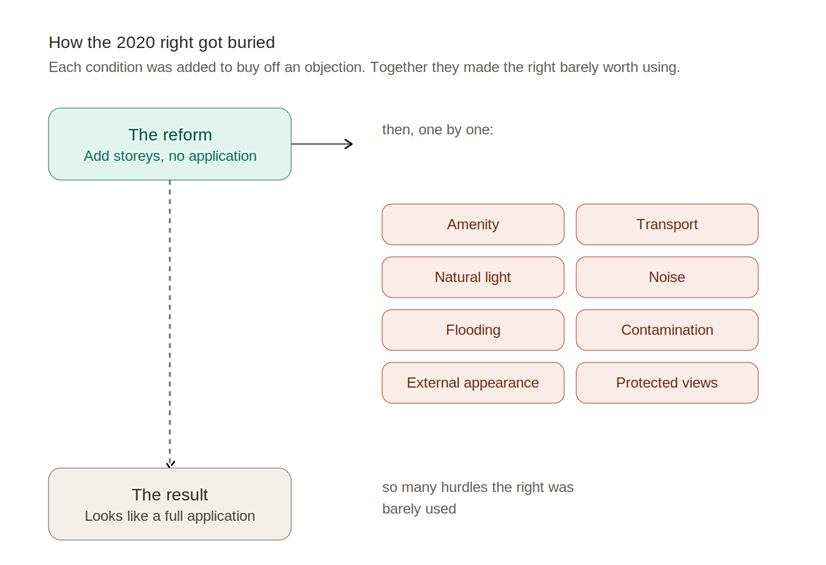
Each condition had been added to assuage a concern MPs and residents were expected to raise. The result was a right so hedged that it made little sense to use. In trying to keep everyone happy, we strangled the policy. I know, because I worked on these reforms in No 10. Almost every policy carries a set of accommodations to buy off objections, that is how parliamentary politics works, but too many of them leave a reform unusable and ultimately useless. I once sat in a meeting where London MPs pressed for the capital to be exempted entirely from a new commercial-to-residential permitted development right. The Prime Minister in the room half-agreed on the spot before, mercifully, forgetting all about it.
Street votes is the same instinct again, giving the people most affected by new homes a direct stake in them being built. The idea is neat on paper, but it looks likely to fail the same test the 2020 PD rights did. Rather than setting a simple default, it creates another elaborate procedure and then asks a street to opt into it and organise itself before anything can happen. There will be the odd street that does it and hopefully many more. But I expect most people won’t care enough to fight through that much complexity. And there is not enough in it for developers, so they won’t push it along either. Without sharpening, it risks becoming another much vaunted reform that ends up as performative legislation.
The lesson from all of these is the same one taught by more successful reforms like the presumption in favour of development. Set a simple policy, and, assuming there are buyers, homes will follow. The state does not need to masterplan every plot or possibility. Give developers enough certainty, don’t overburden them, and they will do what they are already very good at, which is finding sites and bringing them forward. Two changes could work for building up suburbia.
First, strip the prior approval conditions back on the upward-extension and demolition-and-rebuild PD rights until they work, while curbing the Article 4 directions that let councils switch them off street by street. This will annoy some people and it should. Any reform that could shift housing supply annoys someone, and the people it annoys are not fools. They can tell when a change goes against what they want, and no amount of procedural reassurance will talk them round.
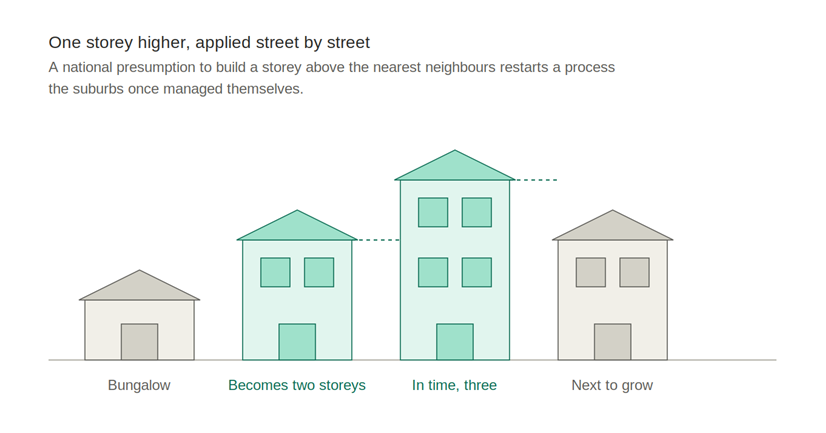
Second, similar to Paul Smith’s proposal, use National Development Management Policies to create a national presumption in favour of building one storey higher than the nearest neighbours, subject to sensible rules on setbacks, overlooking and daylight, and no more. One extra storey sounds modest, and individually it is, but it restarts a process suburbs once managed on their own. A bungalow becomes a two-storey house, and in time some plots grow to three. The Government’s new NPPF, published this week, goes some of the way to supporting this. But it stops short of putting these national policies on a statutory footing, and as a material consideration weighed against everything else, the risk is councils keep finding reasons to say no. Make NDMPs statutory and the impact would be larger, including in London.
Evidence from places like Auckland shows big gains in supply come from reforms that are modest on any single plot but applied widely. Eye-catching schemes like the ‘default yes’ for homes around stations are worth pursuing too, but reform needs to be as simple as possible, not designed to please everyone. What it takes is a government and a minister willing to accept that the reforms that move supply upset people. The ones that upset no one are the ones that do nothing.
None of this means ignoring the public or steamrolling MPs. What people think should shape how a reform is designed and sold. It just means having the nerve to pursue a reform that is difficult and would take an argument to win. So back a handful of heavy metal policies that actually move supply, hold the line when the rumbling starts, and let the suburbs grow again.