

When you realise we spend around £15 billion each year on Housing Benefit, but only around £4 billion building new homes, it becomes easier to understand why Andy Burnham is looking again at the role of the state. For the last forty years, government has become remarkably good at subsidising the consequences of the housing shortage. Less so at increasing supply.
The logic behind Burnham’s argument is straightforward. If you want to decide what gets built, where it gets built and at what pace, you need to reimagine the states role.
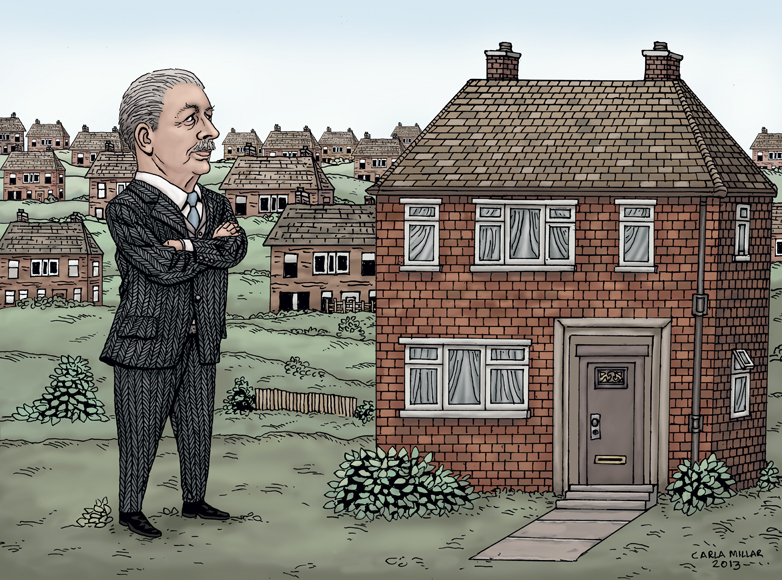
This role or lack of it in todays world was not always the way. For much of the post-war period, the state played a far more direct role in housing delivery reaching in its zenith under Harold Macmillan. The question is not whether Burnham is right to want to rebuild that capacity. It is what that capacity actually looks like.
State Developer or State Capacity?
A chunk of the current debate assumes Burnham wants to create a state-run version of Barratt or Taylor Wimpey. That’s never existed in Britain, and it doesn’t fit especially well with a politician who talks mainly about devolving central power, not concentrating it.
So what did state delivery actually look like in Britian? For thirty years after the war, the state did not subsidise housing so much as build it.
The instrument was the council. The 1947 Town and Country Planning Act gave local authorities their planning powers; the New Towns Act the year before gave development corporations the means to buy land and lay out whole communities. In the quarter century after 1945, councils completed around 3.1 million homes.
Then the model was taken apart. First their was the IMF intervention which began the process. Then the 1980 Housing Act, more known for right to Buy, tightened the limits on how much councils could borrow to build. Output never recovered. Thatcher’s 1988 Housing Act then handed social housebuilding to housing associations, paid for with a mix of government grant and private borrowing. The reasoning was fiscal. A pound of grant given to an association, which could raise private loans against it, bought more homes than a pound given to a council, which could not. So the state stopped building and started paying others to build.
The replacement has never matched the original. Associations have built most of the social housing delivered since, but most of very little is still very little. In 2024-25 they accounted for circa 47,000 homes in England. Set that against the council building peak of 200,000 homes in 1953 and you begin to see the drop off.
This is the history Burnham is reaching back into, but what can we learn from this and how can its former success be replicated today?
The Treasury problem
The biggest constraint may not be planning at all. It may be the Treasury.
The post-war model relied on balance sheets as much as planning powers. Councils borrowed to build, backed by the state, with rental income providing a long-term return. Development Corporations borrowed against future land values, captured the uplift created through development and recycled it into infrastructure.
Housing was treated as an investment, not simply an annual cost. A modern equivalent would require the Treasury to rethink how councils and Development Corporations access finance. The opportunity is to move away from a system dependent on upfront grant towards one where public bodies can invest, build assets and recover costs over decades. This would not eliminate public borrowing. But it could reduce reliance on central government subsidy and allow delivery bodies to operate over 20 or 30-year horizons rather than spending review cycles. For a fiscal devolution junky, this may be the most interesting part of the proposition for Burnham.
Land
The good news for Burnham is that one of the biggest blockers to any of this, the cost of assembling land, has already been half-dealt with, in part thanks to one Michael Gove. In 2023 the Levelling-up and Regeneration Act stripped hope value from compulsory purchase on public interest schemes. Labour then finished the job widening the grounds and extending the reach to the development corporations and mayoral vehicles.
People
Whatever form Burnham’s delivery machine takes, the first step should be an honest assessment of what has and has not worked before. The recent history of council development arms provides plenty of lessons. Lord Kerslake’s review is a good place to start.
Where councils struggled most was their ability to compete with the private sector for people who understood land, finance, commercial negotiation and risk.
That challenge will exist whatever the vehicle. A state developer, a council delivery arm or a new generation of Development Corporation all require the same thing: people who know how to get complicated projects over the line.
Attracting the industry’s best people will not be cheap, but it will be essential. The past two years have seen some of the sector’s most experienced leaders retire or step away. Many would, I suspect, welcome the chance to help build something new, even if only in an advisory capacity.
State and market are not opposites
There is a tendency in housing debates to frame the state and the private sector as competing alternatives. History suggests that is the wrong question. The most successful periods of state-led delivery were rarely the state doing everything itself. Councils and Development Corporations provided the land, infrastructure, finance and long-term vision. Private developers, contractors and investors often provided much of the delivery capability.
A stronger state need not mean a smaller private sector. Done well, Burnham’s delivery machine would strengthen the market rather than displace it.
None of this is certain. But it is worth being clear about what a state machine, done well, could actually do.
Could it be a builder of last resort, taking on the stalled and awkward sites the private sector has looked at and walked away from? Could it be a route back for smaller builders, squeezed out of the market over the past generation? Could it ease the pressure on the Treasury, shifting money from subsidising the shortage, the £15 billion a year that goes on Housing Benefit, towards ending it? Could it capture the land-value uplift that development creates and put it back into the infrastructure that makes more homes possible?
All these things are possible, if it is done well. Whether it is done well, time will tell.