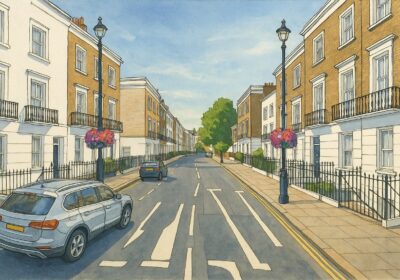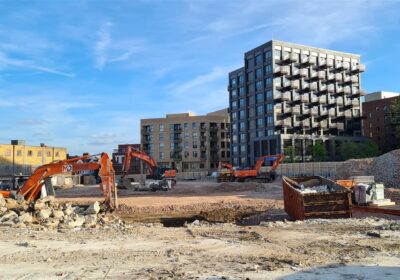

80% of us live in the suburbs. Whilst often the debate around density is characterised around taller and taller buildings, it is within our suburbs that great opportunities can be found for delivering the 1.5m extra homes we need.
We will soon have a revised National Planning Policy Framework (NPPF). This urges us to ‘densify the suburbs’. The Government has suggested changes to speed up the planning process. But the real question is how to design what we need so people might be more supportive of densification.
Metropolitan Workshop has focused for a decade on how to increase density, improve quality and so unlock viability. The market is stagnant for various reasons but part of it is typology driven. Super high density city centre schemes can lack viability because they are reliant on off plan sales making them vulnerable to global volatility. Meanwhile, traditional suburban housing uses land inefficiently because of vehicle dominated layouts, large private gardens, and often its design is not supportive of community development. This is hard to justify in planning and social terms.
There is a real opportunity in the middle of these two housing forms – compact mid-rise suburbs that deliver homes sustainably, sociably, and efficiently. We need to shift from plot-led to place-led development frameworks, with higher density, more bio-diversity, amenity, with mixed-tenures and varied home types.
The Homestead
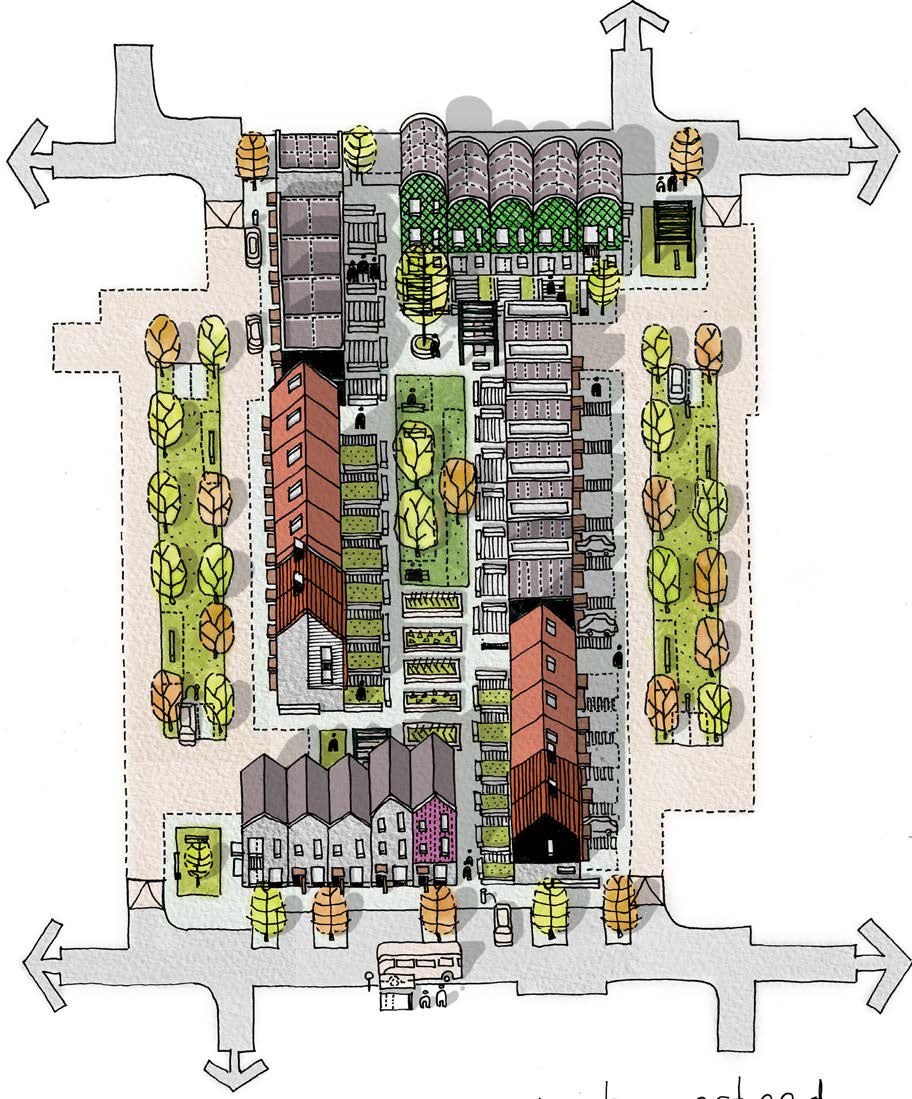
We’ve evolved a model that delivers all this, a flexible unit of development we call The Homestead.
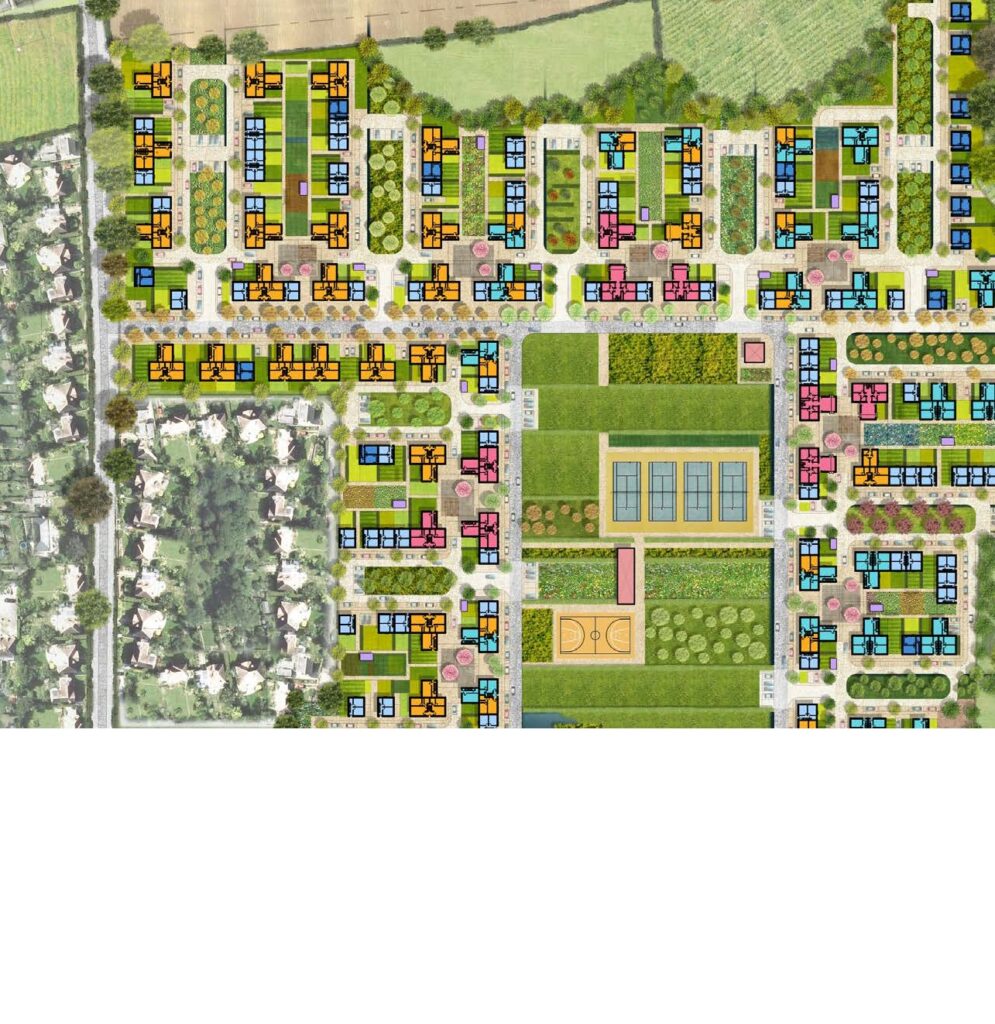
A Homestead is structured around social landscapes, with ‘street gardens’ that link to surrounding neighbourhoods or bigger green spaces, collegial courtyards that suit a variety of lifestyles, like later living, and communal yard spaces that can form a landscaped heart for the Homestead.
The Homestead allows the mix of home types to be highly flexible and responsive to local demographics, and demand. It forges community, limits common parts, and offers variety of character. It should deliver increased affordability and quality because it makes a smaller amount of infrastructure work harder.
It is a repeatable, flexible model that might also offer more feasible opportunity to use modern methods of construction, delivering further benefits.
Indicative layout pattern
Public private partnership
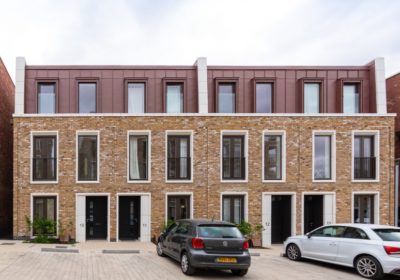
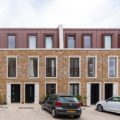
We’ve built six Homesteads on a council-owned brownfield site on the edge of Swindon for Nationwide Building Society. Oakfield provides 239 homes, with integrated later living and a shared social framework of neighbourhood park space.
Should volume housebuilders be interested? While it is tough for innovation to squeeze past their land, planning, construction and sales departments intact, the Homestead’s flexibility around density could prove its biggest attraction. This can drive development values and viability.
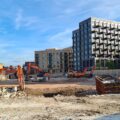
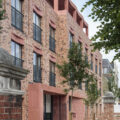
A similar compact approach can also be used to densify backland or tighter suburban sites. We have achieved this on Farmstead Road on the Bellingham Estate in Lewisham, for Phoenix Community Housing. This scheme included three terraced homes and 24 apartments. The corner plot still provides lots of green space but provides a much higher housing density in lower cost, lower rise forms.
If we rethink how we design and deliver suburbia, I beleive we can unlock significant social, economic and environmental benefits.
Neil is Co-Founder and Partner of Metropolitan Workshop LLP, having established the practice with colleagues in 2004. His expertise is focused on complex mixed-use urban projects. He is one of the Mayor of London’s Design Advocates. He has been the Chair of London Borough of Barking and Dagenham’s Quality Review Panel since 2019.