
The Battersea Glassmill decision and the policy that requires a tower to work — then refuses the tower
Last week Rockwell had their application at the Glassmill at 1 Battersea Bridge Road, Wandsworth — a part ten, part twenty-eight storey mixed-use building — dismissed. Perhaps UKREiiF which was happening at the time, is a good moment for bad news.
What happened at Battersea
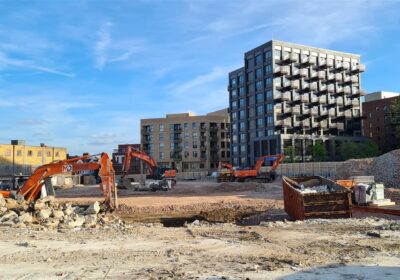
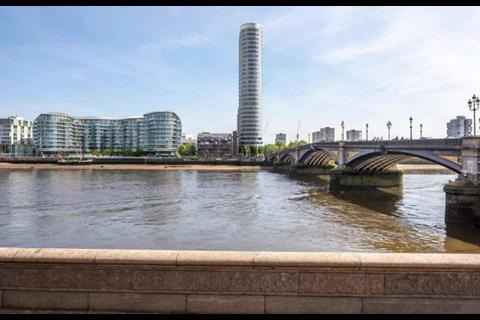
The Glassmill site sits east of Battersea Bridge, directly adjacent to the Thames. A largely vacant 1980s office building occupies the site. Rockwell proposed its demolition and replacement with a mixed-use scheme of 110 residential units — fifty-four of them social rented affordable, at one hundred percent social rent — alongside office, restaurant, and community uses.
Just pause for a moment – very few if any developer led applications offer 50% social rented. Something was afoot.
The proposal was ambitious in every sense. At its maximum, it would rise twenty-eight storeys plus ground floor, fronting the river. The scheme went through twelve pre-application meetings with Farrells promoting — the practice of the late Sir Terry Farrell — and reduced from an initial thirty-five storey proposal through multiple iterations to reach the twenty-eight storey scheme that went to inquiry.
The Inspector found the proposal caused harm to the character and appearance of the area across a wide range of viewpoints. The proposal was, she concluded, “not exemplary, extraordinary, remarkable or distinctive, just tall.” She gave the character and appearance harm very substantial weight.
The benefits of market and affordable housing delivery were considered substantial. But it was not enough and I am not going to relitigate this — I am no townscape expert. However, the Glassmill decision cannot be read without understanding how Wandsworth as a Council were directed by a ruling Labour Group which were swept to power in 2022. Unlike other Labour groups in London, Wandsworth Labour took a reactionary view to development, appear to have taken limited advice and ultimately failed to understand how operational models work in real estate and how they may be harnessed to everyone’s benefit. It is a cautionary tale for new administrations.
Wandsworth: a policy ratchet
Aydin Dikerdem — Cabinet Member for Housing from Labour’s 2022 victory championed Local Plan revisions to uptick the ask on affordable housing. This was ideology over data. The housing market was already beginning to retreat.
The new LP23 policy raised the borough’s affordable housing threshold to fifty percent with a seventy-thirty split in favour of social rent. He described Islington as his inspiration whilst the Mayor of London had to object to the policy his own party were advocating locally.
Other innovations included an in-house viability unit to support the policy. And as the Mayor of London has found from the Murray era, if these teams are not carefully managed, they go from enablers to enforcement units causing deadlock and deterring capital investment. They can generate a circular loop: validating their own assumptions over a development cycle with limited interest in external real data reference points. That leads to progressive distortion in viability appraisals. In Hackney, such a unit mandated a ten percent profit margin as the maximum acceptable in order to squeeze as much as possible. These approaches produce conflict and accelerate housing delivery decline.
Policy virtue signalling didn’t finish there. High-level commitments to rent control were also made. Many Labour members consider this important, and the cost of living crisis is real. But fixing rent levels in the private market is a short-term hack that guarantees one thing: driving landlords out of the market.
When the government and the Mayor announced the October 2025 emergency measures — a new fast-track route for schemes offering at least twenty percent affordable housing — Aydin Dikerdem came out publicly to criticise his own Mayor’s policy direction. Fifty percent of nothing is still nothing. And so is thirty-five percent, for that matter.
The private sector tries to reach out
A simplified picture of the private sector as baddies and public sector as goodies appears to have driven much of the thinking at the top whilst forgetting three simple truths:
- Building costs money, a lot of money at high density.
- The public sector does not have enough money.
- Taxpayers don’t wish to invest in projects at risk of catastrophic losses when the private sector, in the right environment, will do it for you.
Wandsworth would learn these home truths later and by then, it was too late.
Despite all this, there’s no doubt the development community appeared to try to accommodate the new world order. Unfortunately, they were to find themselves up the creek with no paddle.
A number of major schemes went down at committee despite offering generous contributions to affordable housing. Many at the target level set by the majority party.
Greystar was the first to go down at Lombard Road. They brought forward a co-living scheme with a £16.5 million payment which would have equated to 35%. It was not enough and was refused.
Sources tell me, another developer came forward on a separate site with onsite 35% affordable alongside co-living thinking this might address the Lombard Road decision. This was also not good enough and Wandsworth doubled down with a fresh mandate that 50% affordable was to be required for co-living and student housing. So the goalposts were moved to make even generous offers insufficient whilst the market deteriorated.
Springfield Hospital in Tooting is even more instructive. This is a site that has been subject to planning applications for fifteen years. What is routinely described as a simple housing refusal was nothing of the sort.
The masterplan had already delivered a brand new mental health hospital — paid for entirely by the developer. It had restored listed buildings. It had created a thirty-two acre new public park which Labour subsequently listed as one of their biggest achievements in four years of administration.
In March 2024, Barratt brought forward an additional 449 homes on the previously developed southern end of the site, offering fifty percent affordable housing with fifty percent of that as social rent. The committee refused it against officer recommendation. The council’s own legal advisor could not follow the reasoning. The Inspector examining the emerging Local Plan later confirmed the arguments deployed could not apply to previously developed land. The park whose opening local politicians had celebrated as achievement was thus delayed by the same politicians.
In January 2025, Watkin Jones’s Booker site in Nine Elms went the same way. The scheme offered fifty-five C3 homes including twenty-seven at social rent, alongside two hundred and thirty-seven affordable student beds — a hybrid typology designed precisely for a location with two new Underground stations and proximity to multiple central London institutions. Officers supported it. The committee refused it. One member objected to the bike storage. Another argued decisions should be weighted toward the “pram generation” — apparently indifferent to the twenty-seven social rent homes the pram generation would have occupied. The developer had submitted in May 2022. They waited nearly three years for that.
Policy direction — and the Rockwell contradiction
The private sector was showing willing. But Wandsworth appeared disjointed at best. In January 2025, in an interview with the Clapham Junction Insider, Dickerdem pointed specifically to the Glassmill proposal as a “notable case” of a developer using affordable housing provision as leverage to circumvent height policy — and said explicitly: “We have to meet the Local Plan.” But wasn’t that what they were trying to do with the 50% social rented offer?
Across the market it is known that Rockwell had been encouraged by lead Members to push the height in exchange for a substantial social rented offer. That is why it was at twenty-eight storeys. The only way to hit fifty percent affordable without grant on a riverside site is to build very tall. Rockwell understood this. The private position — communicated to Rockwell in pre-application discussions — was that height was acceptable if the affordable offer was right.
Those conversations did not survive contact with the planning committee. Tony Belton — PAC chair and local ward member — thought it was too tall. He also feared that social rented homes in high-rise buildings were unlikely to be successful — citing Winstanley as an example where the evidence on community cohesion was mixed. Back to that later.
When proposals are refused on townscape grounds, the system logs the refusal as a planning outcome and moves on. The policy does not ask why the building had to be that tall. It does not ask whether the threshold that required that height is the reason the scheme failed. It does not adjust.
Rockwell’s design is driven by policy and those policies are in conflict. If you mandate a 50% affordable requirement then your only chance of success is super high density or nothing. And we’re back at nothing again like the previous article – but for different reasons – in Peckham. Wandsworth’s own policies are working against each other as they are in fact across London. Is it any wonder why house building is collapsing.
The cost of getting it wrong
The Glassmill is the headline, but it is not the most expensive consequence of four years of this approach. With refusals racking up, development activity slowed forcing Wandsworth to take more risk.
The majority party was about to find out that development is a rather expensive business and it’s usually better if you allow other people to pick up the bill like the ones who work in the sector day to day.
The Winstanley estate was the first. Wandsworth paid — I have seen a report suggesting the figure was twenty-four million pounds — to exit the regeneration agreement with Taylor Wimpey on the Winstanley estate. This was not a scheme mired in controversy. It was already in progress and delivering. Since the exit, nothing has happened.
The Alton regeneration is in a similar position, although that scheme presents more complex challenges. Winstanley was a case of stopping something that could have worked and paying handsomely for the privilege. £24 million makes the £16.5 million offer from Greystar look like a missed opportunity.
There is also the question of Battersea Power Station Phase 5A. I am not in a position to disclose the detail of what was agreed there. But the principle is straightforward: the council agreed to acquire units to deliver social rent homes alongside GLA grant. The question I would invite any councillor — old or new administration — to answer is how many affordable homes the same money could deliver elsewhere in the borough, with or without GLA grant on some of the schemes that the planning committee knocked out.
“Not the Council’s Responsibility”
There is a passage in the Inspector’s decision that deserves to stand alone because I think it is quite revealing of the mindset in the latter days of this administration.
In its formal Statement of Case, filed in January 2026, Wandsworth argued that only moderate weight should be given to the housing benefits of the Glassmill scheme. The reason: the council had a five-year housing land supply of 5.8 years and a Housing Delivery Test result of 112%. On that basis, the council asserted it was meeting its own housing needs — and that it was not its responsibility to contribute to wider London housing needs.
The Inspector’s response is at paragraph 170 of the decision:
“The Council has asserted that only moderate weight should be given to the provision of housing as the Council is meeting its own housing needs and it is not the Council’s responsibility to contribute to wider London housing needs. In the light of the worsening housing delivery situation and the minimum nature of housing targets, this appears ill-considered.”
“Ill-considered.” That is unusually direct language from a Planning Inspector. It is worth understanding precisely what the council’s argument required her to accept.
London is a single housing market. The London Plan allocates housing targets to boroughs on the basis of London-wide need — not individual borough need. When Wandsworth argues that its responsibility ends at its own HDT score, it is asserting that a borough in one of the world’s most acute housing markets can discharge its obligations by clearing a minimum floor — and then argue against housing weight in individual appeals on that basis.
The Inspector declined. But she is correct to note the argument’s deeper flaw: the 112% HDT score and 5.8 year supply are minimum thresholds, not evidence of adequacy. And how many of those sites in the trajectory are actually going to come forward when developers face a late stage review and an in-house viability unit incentivised to put you into deadlock.
London’s annual housing need has been assessed at 66,000 homes. London completions in 2025/26 fell to 8.1% of the annual target. Against that backdrop, a council arguing it has discharged its obligations because it cleared a minimum delivery floor is not engaging with the crisis. It is hiding behind the machinery.
This is the Wandsworth argument at its logical core: we have met our numbers in the past, we are not responsible for London’s numbers in the present, and the housing this scheme would deliver is of only moderate importance to us. The Inspector found this ill-considered. She still refused the scheme. But her language suggests this is not a borough you want to do business with — and I might agree.
I very much hope the new administration will seek a reset.
In Part 2 we will look at Wandsworth delivery numbers in more detail. Thank you to the many individuals that contribute directly and indirectly to propviews from both the public and private sector to make these articles happen.