

Is it that bad or has the perfect become the enemy of the good?
‘If we are victorious in one more battle with the Romans, then we shall be utterly ruined.”
Has the one more battle with developers been had?
Part 1 of a deep dive by former Southwark Councillor and Borough Planning Chair Nick Dolezal as he delves into the politics that drove the Aylesham Centre decision. For more insights also check out Nick Dolezal: From the Shard to Stalemate: What Went Wrong in Southwark
The perfect storm is here
Since 2014, it has been recognised that the Aylseham Centre should be redeveloped. It is an allocated site within Southwark’s Local Plan. Yet over a decade later, Peckham will still have the tired supermarket that needs to be replaced and a massive surface car park.
On the 9th of October, the High Court denied Berkeley Homes a judicial review of the Planning Inspectorate’s refusal of the mixed-use scheme to replace an ageing supermarket, retain existing traders, create new retail opportunities, and build 867 new homes.
Briefly, when Berkeley submitted their application in July 2024, it included 35% affordable housing of the 867 to be built. By December, things had moved on, and Berkeley had reduced the affordable housing offer to 12%, removed the community land trust, and had appealed to the inspector for non-determination.
When the council then considered the revised report in July 2025 to be able to advise the inspector what the council’s decision would have been, it concluded the reduced offer of affordable housing would not overcome the harm to the conservation heritage assets. This was even though Historic England, the Greater London Authority (GLA), and Southwark Council initially deemed the heritage harm as “less than substantial”.
What if Berkeley had paid the tariff?
Would the scheme have gone ahead if the 35% affordable housing and a community land trust been forthcoming? Would the public benefits have been sufficient to overcome the harm to the conservation area and the heritage assets?
The inspector’s decision was based solely on the grounds that it would harm the conservation area and local heritage assets. Notably, the inspector did not cite the lack of affordable housing in coming to his decision. He recognised that the scheme was not viable and acknowledged that the offer of 12% affordable housing was more than the scheme could justify.
Berkeley then applied to the High Court for a judicial review of the decision to determine whether the decision was ‘lawful’; it would not have considered whether the decision was right or wrong. The judicial review was denied.
What they say
It could be said that all elected members are out of kilter with the facts when focussing on the reduced affordable housing contribution as the reason for the refusal.
With the Greens staying silent on the result of the judicial review but earlier in the year describing the scheme as gentrification on steroids and arguing in the Architectural Journal, “the scheme failed to provide the genuinely affordable social housing that local people desperately need, while pushing a scale of development that would permanently alter Peckham’s character.”
Liberal Democrat’s Deputy of Southwark Council responsible for regeneration welcomed the verdict, saying, “We recognise that market conditions are extremely challenging for developers, but the housing crisis facing our residents is equally acute, saying in the Southwark News, “Berkeley Homes’ proposal for the Aylesham Centre includes a low percentage of affordable housing and does not provide sufficient benefits for the local community.”
The Local Labour Party celebrated by saying, “The verdict is in, and the High Court agrees with us: just 12% affordable housing is not good enough and not what Peckham needs”.
None of them acknowledging that everyone else Berkeley, the council, and the inspector accepts that the scheme is not viable and it could not meet the 12% offer. The scheme was refused because the inspector considered that the harm caused to the local heritage assets to be too great.
What a pickle!
How did Peckham get to the point where a key site designated for a mixed-use development over a decade ago, five minutes’ walk from a station and next to a bus garage capable of providing 867 new homes with 35% of them being affordable, got mothballed for the foreseeable future because of harm to heritage assets?


The front and back of the Aylsham Centre as it is and likely to be for the foreseeable future.
A good starting point is 2014. This was when the site designation and its uses were extensively consulted on. Local amenity groups, led by Peckham Vision, made their views known and influenced how the site should be laid out.
This included arguing for and gaining the concession that the city views from the nearby Bussey building should be protected. Broadly speaking, the plan for the site settled around renewing and retaining the existing supermarket, retaining existing traders, introducing new retail opportunities, and around 800 homes in blocks of between 4 and 20 storeys.
Berkeley Homes acquired the site in 2021 and in 2022 started consulting on a Sheppard Robson scheme pushing the envelope to over 1,000 homes and a 27-storey tower. This scheme was widely criticised locally with Cllr Mcash in his Cabinet Role for Sustainable Development publicly calling for its withdrawal in 2022. He stated that Berkeley had not made the significant changes the council had asked for: reducing the number of homes to around 850 (including 35% affordable), a community land trust, and buildings no taller than 20 storeys.
dRMM was then bought in with Southwark based Jas Bhalla, local architects Nimtim and a really local Bussey Building in Rye Lane, Peckham based architects Feix & Melin and Dowen Farmer. A strong architectural team with a strong understanding of South London, Southwark, the local area, Peckham and the essence of ‘Peckhamness’ itself.
By 2024, they had settled on a scheme reducing the number of homes to 867 and the height of the tallest towers to 20 storeys. At that time, the scheme was still offering 35% affordable homes even though the scheme was evidently going to be under strain with the reduction of the number of homes on offer.
Around this time, Peckham Vision formed a new local community campaign group, Aylesham Community Action, to lead on the objections to the Berkeley scheme. Peckham Vision has a long history of co-ordinating objections to local developments through Peckham Heritage and the Rye Lane Traders, who work very closely together and share memberships. They get support from the umbrella groups 35% Campaign and Southwark Housing and Planning Emergency.
Aylesham Community Action continued their campaign objecting to the scheme, claiming it was still too intrusive, too tall, and not ‘Peckham’ enough, at the same time arguing for increased levels of affordable housing. Aylesham Community Action’s campaign captured the public imagination and more importantly, the support of the local councillors, assembly member, and MP. They all began to call for Berkeley to commit to Aylesham Community Action’s demand for at least 50% affordable housing, some say 60% had been mentioned. They also fiercely defended their right to define ‘Peckhamness’ as they have in the past.
Was this asking too much…
A step too far?
By July 2024, Berkeley decided to go forward with an application in July 2024 with a 35% offer of affordable housing.
However, it became clear it was not sufficient. There was increased pressure from local campaigners supported by the local MP, assembly member, and all three ward councillors demanding at least 50% affordable housing. The lack of political support coupled with spiralling build costs, led Berkeley to revise its affordable housing offer to 12% and removed the community land trust. They decided to appeal to the planning inspectorate on the grounds of non-determination.
Before the appeal was heard, the council planning committee refused the application on the grounds that the 12% offer of affordable housing was not sufficient to outweigh the harms of the scheme.
The inquiry came and went with Berkeley defending its position on viability and the objectors as a third party citing harm to the identity of Peckham and, in particular, the Victorian heritage assets. This is usual in cases of non-determination.
The inspector’s decision to refuse the appeal finally came out just after the local elections in May 2026. Berkeley lost on the grounds of harm to heritage assets in the area and the loss of a connection to Peckham’s rural identity before the expansion of London during the Industrial Revolution. He made it clear that viability was not an issue in refusing the appeal and agreed that the scheme was not viable. PropViews covered the decision here.
The Aylesham Community Action had succeeded in brigading its strong heritage arguments at the appeal and won. Many of the objectors, as members of Peckham Vision, had been heavily involved over decades in preserving the heritage assets in the area, including work on restoring both the locally listed clock tower and the railway station.
So far so…
The local battle had been fought; the local community has seen off the developer by defending Peckham and ‘Peckhamness’ in the pursuit of their image for the area and the defence of heritage.
Viability and the levels of affordable housing were not an issue in the end; the demands for 50% could not be met, the 35% original offer was rejected, and the 12% fell by the wayside. In reality, the scheme, like many across London today, could not sustain any level of affordable housing.
The issue rested plainly and simply on the impact the scheme would have had on local heritage assets and compromising the links the site has with long-lost Victorian origins; links brutally severed during World War 2.
No new supermarket, no new shops or stalls for the existing traders, no new retailers, no new jobs, and importantly, no new homes. Some 867 new homes could have been built in Peckham for people who want to live there and, roughly, between 270 and 80 affordable homes lost; for context, using a current and well publicised example this is roughly the equivalent of losing between one and three council blocks the size of Appleby Blue in Southwark, pictured below.

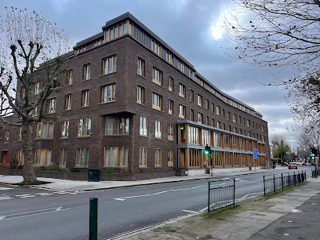
So we end up with fewer ‘genuinely’ affordable homes for the foreseeable future in Peckham. Is this leading us to a conclusion that the local victory may have been pyrrhic and, if so, to what degree are we ruined….
Nick will return for part 2 over the coming days. In the meantime, you can catch up with more on this on PropViews the pod here:
Prop Views | Listen to the Podcast on Spotify
Credit: Architectural Journal, Aylesham Community Action, Mainstream Labour, Peckham Vision, Southwark Council, Southwark News, and others
