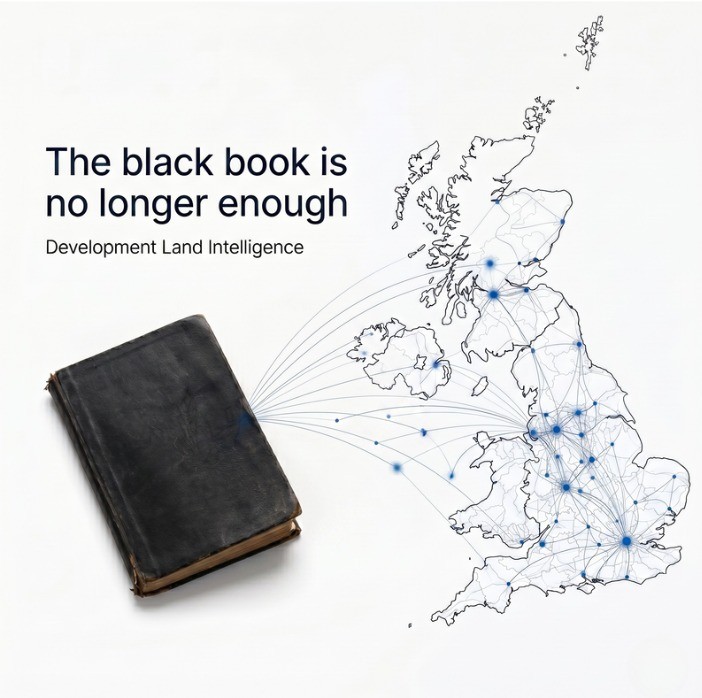

For decades the UK development land and commercial agency market relied on a familiar model: relationships, applicant lists, discreet circulation, personal networks. The agent with the strongest black book was assumed to have the edge.
Relationships, advisory judgement and negotiation still matter. But the market has changed too much for any agency to rely on a closed database alone. The central question is no longer whether an agent knows buyers. It is whether the agent can place the opportunity in front of the widest credible range of buyer types, visibly and currently.
Development sites no longer sit in a simple hierarchy of value. In previous cycles, residential was the obvious highest use; housebuilders set the land value and outbid alternatives. Not any more. Residential viability is under pressure from build costs, planning obligations, regulation, affordable housing, slower sales rates and higher finance costs. Operational and specialist uses are competing more actively for the same sites.
The Buyer Pool Has Fragmented
The shift is visible at the top of the housebuilding market. In April 2026, Berkeley Group paused new land purchases and slowed investment, citing weaker housing market conditions, geopolitical volatility, regulation, costs and reduced expectations for interest-rate cuts (Property Week, 1 April 2026). When one of London’s most sophisticated residential land buyers says it cannot achieve required returns on new land, something has shifted.
Credible alternative-use bidders, including operators in specialist sectors such as self-storage, roadside, urban logistics, data infrastructure, hotels, healthcare, PBSA and senior living, are now competing actively for sites that would once have been written into a residential pipeline. The message is not that every residential site should become self-storage. It is that the relative value of uses can no longer be read from old assumptions.
A single development site may now be relevant to; volume housebuilders, regional residential developers, BTR platforms, affordable housing providers, PBSA and co-living operators, self-storage groups, drive-thru and convenience operators, last-mile logistics developers, hotel and healthcare groups, data centre and digital infrastructure occupiers, EV and forecourt operators, family offices and private capital. Each category has different appraisal methods, funding structures, risk tolerances and timing constraints. Most do not monitor the same channels or respond to the same agency relationships.
That is the flaw in the traditional black book pitch. A black book may be strong within one or two verticals, but the landowner’s best buyer may sit outside both of them. Every developer has a mental map of their market. Every map is incomplete.
Post Parkhurst Sharpens the Pressure on Alternative Use
There is a less visible force pushing alternative-use bidders toward parity with residential: London’s planning treatment of land value for residential housing supply. Where Alternative Use Value is recognised too narrowly, viable land supply for new homes gets suppressed. Landowners hold sites back rather than sell at the values the system produces or they go elsewhere.
Propviews’ recent analysis of Parkhurst Road Ltd v Secretary of State argued rightly that the judgment was later treated as a licence for formulaic EUV+ valuation. Justice Holgate in fact warned that an uplift on existing use value of 10 to 40 per cent is an arbitrary number that does not reflect the workings of the market. But subsequently, London policy decided to accept Alternative Use Value only where an implementable or policy-compliant alternative can be demonstrated, while Parkhurst itself was fact-specific and should not be transplanted mechanically across sites with genuine alternative uses.
For agency practice, the lesson is practical. A site that looks marginal for residential when run through the GLA’s SPG on Viability, now could work for self-storage, PBSA, healthcare or specialist living capital. Acting in the landowner’s best interests now means exposing the opportunity widely enough that the strongest credible buyer can emerge, including buyers the agent may not already know personally.
The Portal Model Has Never Covered the Market
There is something structurally backward about the portal model for development land. The agent does the work: finding the seller, winning the instruction, assessing the site, drafting the marketing material, briefing the photographer. The agent then pays the portal a substantial recurring fee to display that work to a buyer audience the agent’s own effort created. The portal monetises the buyer audience; the agent funds the system that captures it.
The economics are not the only problem. According to Ortelias’s October 2025 research, no single portal even carries half the market for available UK development opportunities. Rightmove Commercial, the largest, carries 46.7 per cent. Zoopla Commercial and PrimeLocation each carry 29.2 per cent; LoopNet 21.2 per cent; NovaLoca 12.4 per cent; The Landsite 2.2 per cent. And 31.4 per cent of marketed UK development land sits on agent websites that no portal aggregates at all. For agents, portal spend is not the same as market coverage.
Ortelias is built as the structural inverse. It is the UK’s first AI-driven professional-grade tool for identifying on-market development opportunities. It monitors more than 3,000 UK estate agent websites at no cost to the agent. A developer describes a brief in natural language; Ortelias returns a ranked shortlist drawn directly from agency websites, with a written assessment of each result against the brief, and an upside flag where the listing has an angle it does not itself advertise.
The economics are inverted. Developers pay; agents do not. There is no listing fee, no commission, no diversion of the buyer relationship. Every result links back to the agent who listed it. Every source named, every contribution honoured.
The strategic implication is direct: portal advertising is no longer the most productive marketing investment. The agency’s own website is.
Freshness Is the New Trust Signal
Stale listings are a trust signal in reverse. A dormant website creates doubt about momentum, professionalism and market reach: three things landowners are evaluating when they choose which agent to instruct. Current, accurate, well-structured opportunities reassure landowners that the agent is actively managing the work, and reassure buyers that the information is worth engaging with.
Buyers increasingly expect to search, compare and qualify before speaking to anyone. Rightmove’s investment in conversational search reinforces a wider behavioural shift. Without strong digital visibility on the agency’s own website, opportunities can remain invisible to precisely the buyer types that might create competition. LinkedIn helps agents stay top of mind, but compounding credibility comes from fresh, structured opportunities on a website buyers can return to when their requirements change.
The Instruction-Winning Pitch Has Changed
The strongest agencies use tools like Ortelias to make their advisory role more credible to landowners. The agent still does the skilled work: interpreting planning risk, advising on value and timing, identifying likely alternative uses, qualifying bidders, testing deliverability, running competitive tension, negotiating terms, protecting the landowner’s position through exchange and completion.
What changes is the second half of the pitch. The best landowner pitch is no longer “we know everyone”. In this market, nobody knows everyone. The stronger pitch is: “We know the market. We will advise you properly. And we will ensure your site is visible to the full range of credible buyer types, through a platform that brings the market to your shop window without putting itself between us and the buyer.”
Practical Questions Every Agency Principal Should Ask
- Are our current opportunities accurate and clearly presented on our own website?
- Do we have a credible way to reach alternative-use buyers beyond our historic database?
- Can we prove to landowners that their site will be exposed to the widest relevant market?
- Are we assuming residential is the strongest use when another operator may pay more or move faster?
- Are we paying portals to display listings while the buyer audience our own work creates sits on someone else’s platform?
- Does our website demonstrate market authority or merely existence?
The Future Advantage Is Credible Reach
The instruction winner will not be the agent with the biggest black book. It will be the agent that combines advisory expertise with credible, fresh and broad market exposure. That is particularly true in development land, where the buyer pool has fragmented and the gap between alternative-use values has narrowed.
Post Parkhurst there is a sharper lesson. If AUV is recognised too narrowly and EUV+ applied too mechanically, viable land supply gets suppressed rather than unlocked. Agents have a stronger obligation to test the real market, expose the opportunity widely, and avoid assuming that the old residential hierarchy still governs value.
For landowners, visibility is value protection. For agents, it is a new instruction-winning argument. The agency remains the trusted adviser. Other search tools tell the buyer what is available; Ortelias tells the buyer what is worth their time. In a tighter, more fragmented market, that is doing the job properly. www.ortelias.com
Bruno Jaczkowski has spent 23 years on both sides of the London land market at JLL, Montagu Evans, BNP Paribas Real Estate and Cliveden Properties. He is co-founder of Ortelias, the UK’s first AI-driven professional-grade tool for identifying on-market development opportunities. Ortelias monitors more than 3,000 UK estate agent websites, free to agents, and brings developer buyers directly to the agent’s own listings. www.ortelias.com